
A Guide to Natural Diffuser Wicks: Finding the Perfect Match for Your Scent


Introduction: The Unsung Hero of Home Fragrance
In any home fragrance arrangement, the wick is the unsung hero, acting as the essential channel that absorbs and gently releases scented oil into your space. While there are many options available, diffuser wicks can be broadly categorized into two main types: natural and synthetic. This guide will focus on the diverse world of natural wicks, exploring their unique properties and aesthetic potential. Whether you are pairing them with delicate Sola flowers or using them as standalone decor, we’ll help you choose the perfect match for your home.
--------------------------------------------------------------------------------
1. The Classic Choice: Rattan Reed Sticks
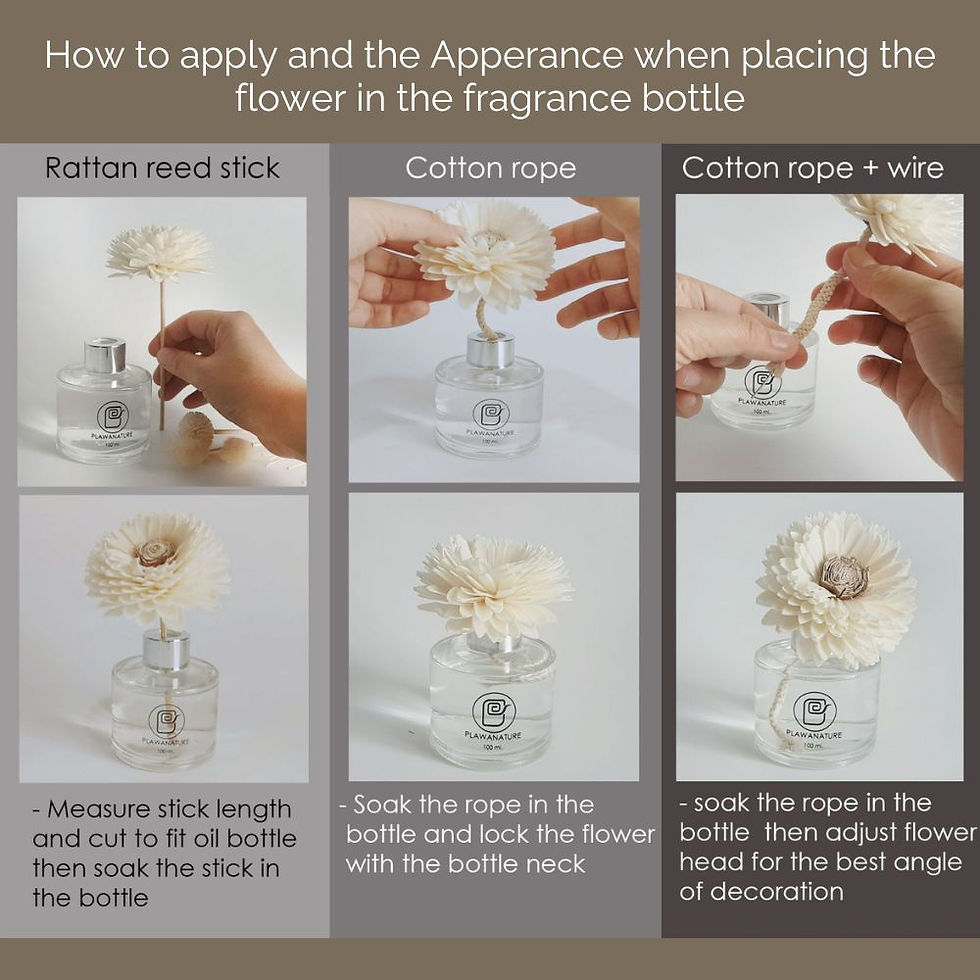
For a classic, understated aesthetic, Rattan sticks are the ideal choice. As a 100% natural wood, they bring an organic feel to any arrangement, though this natural origin also means their performance can have subtle variations.
Key Advantages:
They are a completely natural material, sourced directly from wood.
They offer a small degree of flexibility, which allows for minor adjustments when composing a floral arrangement.
Key Disadvantages:
Their absorption rate can be inconsistent due to natural variations in the wood's porosity.
The hardness and brittleness of the sticks can vary from piece to piece.
When paired with delicate Sola flowers, their straightness creates a more rigid, linear, and architectural look.

2. The Powerful Absorber: Pure Cotton Rope
This is the high-performance option for those who want to maximize scent throw in a small to medium space and don't require stylistic flexibility. Its soft, absorbent fibers are excellent at drawing up and diffusing fragrance oil quickly and effectively.
Key Advantages:
It features a high and rapid initial absorption rate, quickly saturating with fragrance.
It is highly effective at diffusing scent into the room.
Key Disadvantages:
The soft rope lacks any structural integrity and cannot stand upright on its own.
To be used with a Sola flower, the flower must be secured directly to the neck of the diffuser bottle for support, creating a simple, top-heavy look that focuses all attention on the Sola flower itself.
This lack of structure means it cannot be styled or arranged freely within a vase.
3. The Versatile Solution: Cotton Rope with an Inner Wire
In direct response to the structural limitations of pure cotton rope detailed above, this innovative wick was developed. It is the decorator's choice, offering the performance of cotton with unparalleled artistic freedom. It consists of a standard cotton rope with a flexible, rust-proof wire core.
Complete Stylability: It can be bent and shaped in any direction, allowing you to create dynamic, sculptural arrangements without needing to lock it onto the bottle's neck for support.
Enhanced Aesthetics: This flexibility enables more beautiful and creative compositions of Sola flowers, allowing for eye-catching arrangements.
Increased Versatility: It serves as a multi-purpose solution suitable for a wide variety of decorative fragrance displays.
4. The Decorative Form: Broom Weed (Mai Nga)
Broom Weed, also known as 'Mai Nga,' 'Ya Khat Mon,' or 'Bumeed,' is a branched wood prized for its beautiful and unique natural form. While it can function as a wick, it has specific requirements and is typically used for its sculptural quality.
Required Processing: Before use, the wood must be polished to a white color. This process removes a natural, waxy coating on its surface that inhibits fragrance absorption, allowing it to effectively draw up oil.
Primary Use: It is most often used as a standalone decorative stick to showcase its striking form, rather than being paired with a Sola flower.
Limitations: Its naturally inconsistent size and fragility can make it difficult to handle and arrange without breaking.
5. The Delicate Option: Dried Floral Grasses
Only specific types of dried grasses can function as diffuser wicks. To work effectively, they must possess a porous and relatively hollow stem structure that allows for the absorption and travel of fragrance oil.
Example from Thailand: A notable example is "Chompoo Thip" grass, which is characterized by small decorative flowers along its branches. This unique material weaves a delicate, airy texture into the arrangement while also serving as a functional wick.
--------------------------------------------------------------------------------
A Brief Note on Synthetic Wicks
While this guide focuses on natural materials, it's worth briefly mentioning synthetic fiber wicks. These are engineered specifically for diffuser use and offer a different set of trade-offs.
Pros:
They are manufactured for perfect consistency in size.
They offer a highly reliable and uniform rate of fragrance absorption.
Their performance in terms of scent diffusion is considered very good.
Cons:
Their appearance can look stiff and unnatural.
They are completely rigid and cannot be bent or styled for creative arrangements.

Conclusion: Choosing the Right Natural Wick for You
The ideal natural wick depends on balancing your priorities between aesthetics, performance, and versatility. Rattan offers a classic look, while pure cotton rope provides powerful diffusion. For ultimate creative freedom, the wired cotton rope is unmatched, and materials like Broom Weed serve a primarily decorative purpose. Ultimately, the perfect wick is an extension of your personal style. By choosing thoughtfully, you transform your diffuser from a simple fragrance source into a truly intentional piece of home decor.


Comments